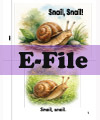

Snail, Snail! /sn/ Emergent Reader

What you need:
Snail, Snail! /sn/ Emergent Reader printables
Learning Skills and Standards:
Letter-sound recognition (/sn/ blend)
• Phonological awareness
• Early reading skills (tracking print, repetition)
• Vocabulary development
• Fine motor skills (optional extensions)
• Listening and speaking skills
What you do:
Preparation:
• Print and assemble the Snail, Snail! emergent reader (one per child or for group use)
• Prepare picture cards or real objects for: snail, snow, snack, snake
• Optional: snail puppet or toy for engagement
• Chart paper or board for writing /sn/ words
Introduction
- Gather children for circle time.
- Show a picture or toy snail and ask:
“What animal is this? How does a snail move?” - Introduce the /sn/ sound:
“Listen: ssssnnn… snail. Can you say /sn/?” - Have children repeat the sound and think of other /sn/ words.
Activity Steps
1. First Read (Teacher Model)
- Read the book aloud slowly and clearly.
- Point to each word as you read.
- Emphasize the /sn/ sound:
“Snail… snow… snack…”
Snail, Snail!
Snail, snail.
Snail is slow.
Snail sees snow.
Snail says, "A snack!"
Snail snaps a leaf.
Snail and snake slide.
Snail says, “Sn… sn… slow!”
Goodnight, snail.
2. Interactive Read
- Read again and invite children to join in.
- Pause before /sn/ words and let children fill them in.
- Add simple motions:
Snail is slow → move fingers slowly
Snail snaps a leaf → pretend to “snap”
Snail and snake slide → slide hands
3. Sound Focus
• Ask: “What sound do you hear at the beginning of snail?”
• Repeat several /sn/ words together:
snail, snow, snack, snake
• Sort pictures:
/sn/ words vs. non-/sn/ words
4. Independent or Small Group Practice
• Children “read” their own books by:
Looking at pictures
Repeating familiar phrases
• Encourage them to track print with their finger.
Extension Activities
Fine Motor / Sensory
• Let children move a small “snail” along a path while saying /sn/ words